If you are familiar with Asian American terminology, you would know what being called a "banana" means. The banana fruit is yellow on the outside and white on the inside. If an Asian person is called a "banana" (or as one of my China friends put it 香蕉人 - "banana person"), it means that he has yellow skin (or looks completely Asian on the outside) but his language, thinking and behaviour is completely western (or "white").
Eggs, on the other hand, have white shells (at least duck eggs and some chicken eggs do!) and contain a yellow yolk in the centre. My white American friend who lives in Hawaii calls himself an "egg". He has a Japanese-American wife. He is the opposite of the "banana". He may be a white American on the outside, but his thinking and value system is completely Asian.
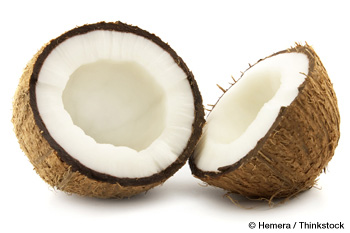
My Samoan friend is brown-skinned. He grew up speaking Samoan, but he spent a large part of his life in the mainland USA. His thinking and behaviour is completely western. One day, when a few of us were describing ourselves as "bananas" or "eggs", he walked by and said, "Just call me a 'coconut'." We all promptly burst out laughing.
I have always considered myself a "banana". I was born into an English-speaking home environment. Nobody spoke Mandarin. Three of my four grandparents spoke English. The other grandparent was unschooled. She only spoke Cantonese. Since I was despised from birth since I am female, she hardly spoke to me. I attended an English-speaking Catholic school. All of us scraped through Chinese lessons, doing much better at English.
In my adult working years, I was thrown into a Chinese-speaking environment. I was forced to speak, and later on try to read the newspapers daily as part of my job. Many years later, I decided to start all over again, reading my Bible daily with a dictionary by my side. I am still not fluent, neither can I read well, but I manage. The greatest compliment I received sometime ago was from a friend from China. He said, "妳已经不是香蕉人了!“ ("You are no longer a banana!") He went on to tell me how much he enjoyed my sermons in Chinese because he received insights that he did not get from sermons in English. I was moved to tears.
I still consider myself a "banana" today. Will that ever change? I don't know. Suffice it to say that the colour of my skin does not define who I am. Neither should you be defined as such. Just be yourself!
Here's to individuality and diversity!
Anything about language and culture. Similar words in different languages, Communication breakdowns. Grammar and spelling. Difficulties in learning a language and tips to help you. Cross-cultural differences. Food culture. Bridging the cultural gap.
Showing posts with label Asian. Show all posts
Tuesday, 17 June 2014
Tuesday, 2 July 2013
Farm-bred insects - just not the same!
Insects? Ewww! That's the standard answer you'd probably get from a western person. Western educated Asians will probably give you the same response. Then you actually go to Asia and find that insects are really good food! Sometimes, they are considered a delicacy to be savoured, thus paying a high price for bugs that run all over your dirty home. Haha
Well, in today's world that is saturated with gourmet food, Thailand has decided that they will fill the hunger for exotic insects. So instead of farmers catching the insects in the wild and cooking them (thus the supply is entirely subject to weather conditions and availability of insects scuttling around), they've decided to create insect farms. Now, ants are cultivated for food. Breeding them must have become a science.
Now the western person who is daring enough to try insects does not have to worry about hygiene. Farm-bred insects are clean, aren't they?
True, but as with farm-bred poultry, the meat just does not taste the same as those caught in the wild. We Asians like free-range chicken, skinny, small in size, tough meat, but oh so tasty! Sooner or later, I think those who have tasted wild insects will not enjoy the farm-bred ones. They just aren't as tasty. Ditto for frogs. The wild ones have sweeter meat.
Having said all that, fried spiders anyone?
Get a book on cross-cultural learning and living today!
Fun Language Tools
Thursday, 4 April 2013
Noodles, truly Asian food
How people eat rice and the difference between Chinese and Korean ways of eating got me thinking about noodles.
Noodles are a truly Asian food. Before there was spaghetti, Marco Polo visited China, saw noodles (and probably tasted them), then brought noodles back to Italy. Today, pasta is made by machine, but the Chinese still make noodles by hand. There are so many traditional ways to make noodles. Just to name a few: hand pulling, cutting the flat dough into strips with a knife, sitting on a long bunch of bamboo sticks and jumping up and down over the dough to cut it up.
Regardless of how it is made, noodles are long strings of dough that can be tricky to eat. Is there a correct way to eat noodles? It all depends on which country you are in. Can you use chopsticks? That would help a lot.
In general, noodles are fried or served in soup. Fried noodles that are dry may be easier to eat, since they will not splash gravy onto your clothes. When the fried noodles have gravy or noodle soup, you will need a spoon to help you. Many websites tell you to slurp up the soup noisily (the louder, the better) to compliment the host. However, that practice is outdated. We Asians have adopted the Western ways of eating quietly. The only noise we should hear is that of friendly chatter, not slurping. Even the Japanese today will frown on someone slurping up his soup. It just isn't the norm anymore.
So before you go anywhere new, do read up on the Do's and Don'ts of a culture, but don't take what you read as truth. It's best to observe the locals and ask as many questions as you like. What impresses your host most is not how much you know about their culture but how eager you are to learn about them.
Have fun! Learn the language in the process and impress your hosts even further!
Fun Language Tools
Wednesday, 30 January 2013
Do Asians hug each other?
It is very common for Asian women to hug in public, especially among the younger crowd. Men? No way! Hugging is sissy! Worse, people will think they're gay. Homosexuality in most parts of Asia is still frowned upon, not celebrated. Hugging between men and women? They will be viewed in the same way as if they were having sex in public. Unacceptable behaviour.
A Junior High School class in America were doing a lesson on the Seven Wonders of the World. Each listed what they thought were the official list, then the class voted and narrowed the list down. One quiet girl was asked what her list was because she didn't say anything during the lesson.
I've been pleasantly surprised in the last year or so that my Asian male friends do ask me for a hug. They're not perverts, neither are they "the special someone". They're my good friends! I enjoy their company, just as much as they do mine. We hug because we want to express our joy at meeting each other again. Maybe Asian culture is changing to be more expressive and less repressive.
Let's spread the love around with a friendship hug!
Fun Language Tools
"Hugging is a good medicine. It transfers energy and gives the person hugged an emotional lift. You need 4 hugs a day for survival, 8 for maintenance and 12 for growth. Scientists say that hugging is a form of communication because it can say things you don't have the words for. And the nicest thing about a hug is that you usually can't give one without getting one." - quotedMy Cambodian friend who is rather western in her ways posted the above quote. I love it! I love hugs too!
A Junior High School class in America were doing a lesson on the Seven Wonders of the World. Each listed what they thought were the official list, then the class voted and narrowed the list down. One quiet girl was asked what her list was because she didn't say anything during the lesson.
"I think the Seven Wonders of the World are:Human beings regardless of culture are the same. We are all made to love and be loved. Anybody young or old will enjoy being hugged. I do!
1. to touch...
2. to taste...
3. to see...
4. to hear... (She hesitated a little, and then added...)
5. to feel...
6. to laugh...
7. and to love.
I've been pleasantly surprised in the last year or so that my Asian male friends do ask me for a hug. They're not perverts, neither are they "the special someone". They're my good friends! I enjoy their company, just as much as they do mine. We hug because we want to express our joy at meeting each other again. Maybe Asian culture is changing to be more expressive and less repressive.
Let's spread the love around with a friendship hug!
Fun Language Tools
Tuesday, 29 January 2013
Culture change begins with me
More stories on Asian nosiness. Or at least what the non-Asian perceives as nosiness.
I first visited Cambodia in 1994, then stayed a year to work there, beginning 1995. This was how we introduced ourselves to each other:
Khmer: (Hands clasped in front of you as though in prayer) Hello.
Foreigner: (Respond with same hand gesture) Hello.
Khmer: Where are you from?
Foreigner: I'm from America (or whatever country you come from).
Khmer: How old are you?
Foreigner: Old enough (said with a big smile)
Khmer: Are you married?
Foreigner: Yes (or No)
Khmer: How much is your salary?
Foreigner: Not much, but compared to your country, a lot. Remember, things are very expensive in my country.
Notice that the Khmer person never asked for a name. You see, in Khmer culture, names are not important. Age, marital status and salary are public information. To the western person, age and salary are classified or restricted or private information! But, the Khmer has no ill-intent. They want to know how old you are, so that they can address you by the correct term: older sibling, uncle, aunt, grandmother, grandfather, teacher, etc. It is not polite to call someone by name. The correct title must be used.
Thankfully, times have changed in Phnom Penh, Cambodia. By the time we entered the year 2000 and beyond, anyone under age 25 years would introduce themselves the western way, by saying his name first. Age is still somewhat public information, but not salary. Young people said they hate it when their older relatives tell everyone how much they earn. If you earn a lot, telling everyone is to show off. If you earn a little, it's too embarrassing to tell others. The young don't like it.
So, does culture change over time? Yes. It begins with a group of people who refuse to follow the trend, but set a new trend instead. What good trend do I want to set for my culture?
Fun Language Tools
Monday, 28 January 2013
Why are Asians so nosey?
Asians can be so intrusive. And this applies to Asians anywhere in the world, including those who reside outside Asia.
My Singaporean Chinese friend moved back to Singapore, after many years in the US. While her new home was undergoing renovations, the lady living next door barged right into the messy living room, took a quick look at the on-going work, and barked at my friend, "How much are you paying for the renovation?"
My alarmed friend managed to mutter something like, "Around $40,000." Not satisfied, the lady demanded, "40-what thousand?" She refused to leave until she had extracted the exact amount from my friend.
A family friend who is also Singaporean Chinese, lives in Australia and attends a church with a large Asian congregation. Shortly after the university exam results were announced, Asian members of the church marched up to ask my friend how her son had done. Knowing that her son hates such intrusion, she diplomatically replied, "Oh, he did well." Not satisfied, the nosey people shot back, "How WELL did he do?" Being a corporate high flier, she was used to such nonsense and revealed nothing. These nosey folks then went to the son to ask for his detailed scores!
I can cite so many more similar stories. Westerners would be mortified at such perceived rudeness. Thankfully, many young Asians have grown to detest such behaviour, preferring the politeness of the Western ways.
Perhaps the communal nature of Asian culture breeds a "no secrets" way of life. Privacy is unheard of. Whatever you own or have achieved is common knowledge and sometimes the subject of much jealousy. Is this a good thing?
Personally, I think not. I am a product of both east and west, but more west than east. I respect people's privacy. I do not intrude, and hope that others do the same to me. But sometimes, going cross-cultural forces me to exercise diplomacy without treading on people's toes. Will Asians change? I think so. Once the older folks who perpetuate this nosey-parker behaviour die off, this habit should die with them. The young generation of Asians do not poke their noses into other people's affairs.
Respect another's privacy. It breeds good relationships. Respect another's culture. You will both be happier for it.
You can read all about different cultures at Fun Language Tools.
Happy learning!
Subscribe to:
Posts (Atom)