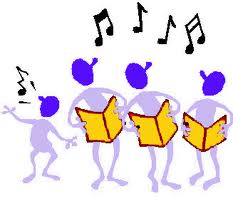
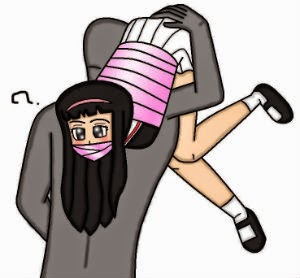
I spotted this sign in the toilet at a coffee shop in Singapore. While I understood what the Chinese text was trying to say, I was baffled at what the English text was supposed to mean. Another case of "lost in translation". Maybe even "clueless in translation".
Let's first dissect the Chinese text 来也匆匆,去也冲冲.
This is a play of two words having similar sounds. (I cannot say the sounds are the same because the Hanyu Pinyin for 匆匆 is cong1 cong1, while the Hanyu Pinyin for 冲冲 is chong1 chong1. Sounds similar to the untrained ear, but very different when you have to input the characters in a text.) The first part of the sentence 来也匆匆 means "enter hurriedly". The second part of the sentence 去也冲冲 means "flush (the toilet) when you leave". Given that this is a sign in a toilet, it makes perfect sense. A simple reminder to keep the toilet clean for the next user.
But what does "easy come, easy go" have to do with toilet cleanliness? Usually, this phrase is used to describe the difficulty in saving money. This is definitely the wrong context for this phrase. Someone who cannot read Chinese would look at this phrase and wonder what the management is trying to tell him/her. The picture tells me the phrase has something to do with using the toilet. But what am I supposed to do other than just use it?
Perhaps I am reading too much into a sign.
But aren't signs supposed to tell you something clearly?
A picture paints a thousand words. In this case, I have no idea what the picture or the English words are trying to say.
So much for reminding me to keep the toilet clean.
Lost? Clueless? Yes, that's me right now.
Have fun with languages!
Anything about language and culture. Similar words in different languages, Communication breakdowns. Grammar and spelling. Difficulties in learning a language and tips to help you. Cross-cultural differences. Food culture. Bridging the cultural gap.
Showing posts with label English. Show all posts
Thursday, 24 March 2016
Friday, 18 March 2016
Tuesday, 1 March 2016
Similar sounds, different meanings
Have you ever gotten two very similar words mixed up, and ended up with an entirely different meaning to your sentence?
Here's an example I saw on someone's PowerPoint presentation on social ills. The presenter wrote "phonography" instead of "pornography".
Phonography is "phonetic representation or spelling".
Pornography is "printed or visual material containing the explicit description or display of sexual organs or activity, intended to stimulate sexual excitement".
Not only are these two words very different in meaning, they are completely unrelated to each other. In the context of social ills, phonography has absolutely no place.
I do not think the presenter knew that he had made a mistake. For that matter, I do not think any of the audience noticed the grave error! Or, if anyone did, perhaps he was too polite to say anything. Whatever the case, a mistake is a mistake.
If in doubt, always check the dictionary. It is far more reliable than auto-correct.
A small error can cost you a lot.
Better to be safe than sorry.
Here's an example I saw on someone's PowerPoint presentation on social ills. The presenter wrote "phonography" instead of "pornography".
Phonography is "phonetic representation or spelling".
Pornography is "printed or visual material containing the explicit description or display of sexual organs or activity, intended to stimulate sexual excitement".
Not only are these two words very different in meaning, they are completely unrelated to each other. In the context of social ills, phonography has absolutely no place.
I do not think the presenter knew that he had made a mistake. For that matter, I do not think any of the audience noticed the grave error! Or, if anyone did, perhaps he was too polite to say anything. Whatever the case, a mistake is a mistake.
If in doubt, always check the dictionary. It is far more reliable than auto-correct.
A small error can cost you a lot.
Better to be safe than sorry.
Wednesday, 17 February 2016
Construction or contraction?
My friend spotted this sign in Phnom Penh, Cambodia. His comment was, "No wonder they are hard at labor."
The words in Khmer say, "Under Construction". This is correct. The one who provided the English text needs to go back to school. It's probably a man, since men do not have contractions.
Maybe his English is under construction, or under contraction so he can't think straight.
Whichever the case, it always pays to check a few times before sending the final text for print.
Have fun with English!
The words in Khmer say, "Under Construction". This is correct. The one who provided the English text needs to go back to school. It's probably a man, since men do not have contractions.
Maybe his English is under construction, or under contraction so he can't think straight.
Whichever the case, it always pays to check a few times before sending the final text for print.
Have fun with English!
Thursday, 11 February 2016
Porn or Prone?
A friend posted this picture on Facebook.
Can Porn be an accident? Hmmm. Well, some men would tell you they were searching for something on the internet and a porn website popped up. Accident? Yes. But only if he shut it quickly. No, if he could not take his eyes off the pictures.
I digress.
This sign should read:
It pays to check several times, and with someone who has better English, than to end up being a laughing stock. With today's technology, a misspelled sign can go viral and make you a laughing stock worldwide. If you enjoy that kind of publicity, be my guest. I would rather be correct and unnoticed.
Correct spelling does have its benefits.
Have fun with English!
Can Porn be an accident? Hmmm. Well, some men would tell you they were searching for something on the internet and a porn website popped up. Accident? Yes. But only if he shut it quickly. No, if he could not take his eyes off the pictures.
I digress.
This sign should read:
ACCIDENT PRONE AREAAccident Prone means you are highly likely to meet with an accident in the vicinity. Therefore, you should stay clear or walk at your own risk. Whoever painted the sign obviously cannot spell. After all, "porn" and "prone" have the same letters in different order.
It pays to check several times, and with someone who has better English, than to end up being a laughing stock. With today's technology, a misspelled sign can go viral and make you a laughing stock worldwide. If you enjoy that kind of publicity, be my guest. I would rather be correct and unnoticed.
Correct spelling does have its benefits.
Have fun with English!
Tuesday, 26 January 2016
"Is this whiskey?"
Obviously a stereotype of Chinese people speaking English. Hmph.
That being said, Chinese people around the world hardly speak English like this! Somehow this stereotype from maybe before World War II, has carried on till today.
The world of spoken English has changed.
Looks like stereotypes need to be updated too!
P.S. In case you are wondering what the joke is all about, this is the text in proper English:
(Source: https://www.facebook.com/photo.php?fbid=10153781743927174&set=gm.1537916159833865&type=3&theater)
That being said, Chinese people around the world hardly speak English like this! Somehow this stereotype from maybe before World War II, has carried on till today.
The world of spoken English has changed.
Looks like stereotypes need to be updated too!
P.S. In case you are wondering what the joke is all about, this is the text in proper English:
Two Chinese dudes break into a distillery.
One turns to the other and says, 'Is this whiskey?'
The other one says 'Yes, but not as Risky as robbing a bank'!!
(Source: https://www.facebook.com/photo.php?fbid=10153781743927174&set=gm.1537916159833865&type=3&theater)
Wednesday, 20 January 2016
Ling and bling
My Sydney cousin posted this photo on Facebook. She felt the line "You ling, we bling" was either a grammatical error or a rather racist statement. I can't blame her. In today's politically correct world, we really shouldn't be playing up stereotypes.
Well, as it turns out, Miss Chu wrote a very clever tagline and has won a copyright for it! (How do I know? One of my cousin's friends said so.)
While I am all for good grammar, proper spelling, and absolutely NO LAUGHING at someone's inability to pronounce English words correctly, my first thought when I saw the line "You ling, we bling" was more a play up of stereotypes to create maximum impact in marketing and promotion. In this case, it is an Asian (Vietnamese, to be specific) making fun of Chinese people who find difficulty in distinguishing between "r" and "l". Does that make it forgivable? Maybe.
Since the owner of this place is far from offended by this stereotyping, I can safely say the rest of us should not take offence either. After all, she does have a court-approved document to use her tagline!
In the name of fun, why don't "you ling" for some bánh cuốn (Vietnamese rice rolls) and Miss Chu will gladly "bling" them to you. Just make sure you have cash handy to pay for it.
Bon apetit!
Note: This post was entirely inspired by the photo. I have never been to Miss Chu, nor tried the food there; neither have I been paid to write this post.
Well, as it turns out, Miss Chu wrote a very clever tagline and has won a copyright for it! (How do I know? One of my cousin's friends said so.)
While I am all for good grammar, proper spelling, and absolutely NO LAUGHING at someone's inability to pronounce English words correctly, my first thought when I saw the line "You ling, we bling" was more a play up of stereotypes to create maximum impact in marketing and promotion. In this case, it is an Asian (Vietnamese, to be specific) making fun of Chinese people who find difficulty in distinguishing between "r" and "l". Does that make it forgivable? Maybe.
Since the owner of this place is far from offended by this stereotyping, I can safely say the rest of us should not take offence either. After all, she does have a court-approved document to use her tagline!
In the name of fun, why don't "you ling" for some bánh cuốn (Vietnamese rice rolls) and Miss Chu will gladly "bling" them to you. Just make sure you have cash handy to pay for it.
Bon apetit!
Note: This post was entirely inspired by the photo. I have never been to Miss Chu, nor tried the food there; neither have I been paid to write this post.
Tuesday, 5 January 2016
Uncle???
I was watching a video of a group of men in Taipei, Taiwan, giving a performance of two songs in a church service. At the end of their short performance, the pastor of the church came up and asked the congregation if they wanted to hear more. He was speaking in Mandarin, saying, "有没有 "uncle"?聚会之前,他们有跟我说有没有 "uncle", 他们还是会唱多一首歌。" (English translation: Is there an "uncle"? Before the service, they told me they would sing another song even without "uncle".)
While the pastor was speaking, I was puzzled. What does "uncle" have to do with singing?
In the middle of their last song, I realised what "uncle" was. "Encore"! That's what the pastor was saying! He was asking the congregation if they wanted to hear more songs. If they did, then they should be saying, "Encore! Encore!"
Chinese English.
Mangled pronunciation.
Understand the context.
Having encountered many different nationalities speaking English, I am actually pretty good at deciphering what people are trying to say. This one stumped me. I suppose the context of a church service didn't help in this case. But, I got it in the end. It can get frustrating, but more often than not, I choose to celebrate the variety of English spoken around the world.
Let's celebrate variety and uniqueness!
While the pastor was speaking, I was puzzled. What does "uncle" have to do with singing?
In the middle of their last song, I realised what "uncle" was. "Encore"! That's what the pastor was saying! He was asking the congregation if they wanted to hear more songs. If they did, then they should be saying, "Encore! Encore!"
Chinese English.
Mangled pronunciation.
Understand the context.
Having encountered many different nationalities speaking English, I am actually pretty good at deciphering what people are trying to say. This one stumped me. I suppose the context of a church service didn't help in this case. But, I got it in the end. It can get frustrating, but more often than not, I choose to celebrate the variety of English spoken around the world.
Let's celebrate variety and uniqueness!
Monday, 28 December 2015
MeetingS kills
A friend was preparing slides for a training session entitled "Meeting Skills". In the process of typing the title slide, she realised that with a small typo, you will get an entirely different meaning:
If the meeting goes on and on, you may find enthusiasm "killed". People will find excuses not to attend the meeting, or be physically present but mentally somewhere else.
Get the right meeting skills or risk killing others (or getting killed) by meetings.
Have fun at your next meeting!
"MeetingS kills"Anyone who has ever sat through a meeting can testify that on the whole, meetings are a dreaded necessity. This is especially true if the Chairperson does not know how to keep the agenda moving in a quick and efficient manner. Discussions can go completely out of hand if not directed well. An agenda with only a few items ends up lasting hours because people were allowed to talk freely on anything superficially related to the topic. Hence, skills are required to conduct meetings so that the business gets done in as short a time as possible. Chop, chop ... and the meeting is over. Work can commence.
If the meeting goes on and on, you may find enthusiasm "killed". People will find excuses not to attend the meeting, or be physically present but mentally somewhere else.
Get the right meeting skills or risk killing others (or getting killed) by meetings.
Have fun at your next meeting!
Wednesday, 25 November 2015
Caesar ate no scissors in his salad
Social media in Malaysia is buzzing with the latest news about salad served at a Parliament dinner.
The menu said: "Scissors Salad". The dish appeared: Ceasar's Salad.
Dessert was: Cream Brule. The dish: Creme Brûlée.
What went wrong? No one has come outright to say so, but it can be easily blamed on lack of proofreading before going to print.
The caterer obviously typed what he had heard pronounced, without checking with anyone. Unforgivable? Yes, because it is an important dinner.
Blame the poor standard of Malaysian English? That would be very mean. It can happen anywhere in the world! After all, the only English spoken around the world is bad English (according to my South African friend). Even the best of us can make mistakes. Let's take them as lessons to be learned quickly and not to be repeated ever again.
In the meantime, rest assured that the salad only contained vegetables and other food items, no scissors.
Bon appetit!
The menu said: "Scissors Salad". The dish appeared: Ceasar's Salad.
Dessert was: Cream Brule. The dish: Creme Brûlée.
What went wrong? No one has come outright to say so, but it can be easily blamed on lack of proofreading before going to print.
The caterer obviously typed what he had heard pronounced, without checking with anyone. Unforgivable? Yes, because it is an important dinner.
Blame the poor standard of Malaysian English? That would be very mean. It can happen anywhere in the world! After all, the only English spoken around the world is bad English (according to my South African friend). Even the best of us can make mistakes. Let's take them as lessons to be learned quickly and not to be repeated ever again.
In the meantime, rest assured that the salad only contained vegetables and other food items, no scissors.
Bon appetit!
Monday, 23 November 2015
Fat or VAT?
My Malaysian Chinese friend working in the UK wrote this on her Facebook:
From a linguistics standpoint, the letters 'v' and 'f' are very similar in sound. Blow air through your upper teeth while bringing your lower lip up to the edge of your upper teeth. Then make the sound for 'v' or 'f'. It is so easy to get the two sounds mixed up.
In some words such as 'verb', if pronounced 'ferb', would make no sense whatsoever. The hearer might even wonder if the speaker wants a 'herb' instead.
However, in my friend's case, she almost sent the customer to the wrong counter! Apart from the different pronunciation of 'VAT', her Chinese mind (aka foodie mind), was thinking about any kind of food that contains high amounts of fat. Hence, roast pork.
Moral of the story: try not to process everything you hear through your own cultural mindset. Take a step back and try to understand the speaker's standpoint before offering an answer. When that fails, ask questions. At all costs, try to avoid misunderstanding. At all times, keep a big smile on your face and show interest. When words fail, the smile melts the coldest heart.
Have fun listening to and trying to understand different pronunciations of English!
"Customer confronts me today and repeats "fat fat fat where is the fat"... Took a few seconds to realize he was looking for the VAT counter and thankfully directed him there instead of to the queue for roast pork."English as it is pronounced by different nationalities.
From a linguistics standpoint, the letters 'v' and 'f' are very similar in sound. Blow air through your upper teeth while bringing your lower lip up to the edge of your upper teeth. Then make the sound for 'v' or 'f'. It is so easy to get the two sounds mixed up.
In some words such as 'verb', if pronounced 'ferb', would make no sense whatsoever. The hearer might even wonder if the speaker wants a 'herb' instead.
However, in my friend's case, she almost sent the customer to the wrong counter! Apart from the different pronunciation of 'VAT', her Chinese mind (aka foodie mind), was thinking about any kind of food that contains high amounts of fat. Hence, roast pork.
Moral of the story: try not to process everything you hear through your own cultural mindset. Take a step back and try to understand the speaker's standpoint before offering an answer. When that fails, ask questions. At all costs, try to avoid misunderstanding. At all times, keep a big smile on your face and show interest. When words fail, the smile melts the coldest heart.
Have fun listening to and trying to understand different pronunciations of English!
Monday, 12 October 2015
Confusing? No, not confusing
Dr Tu You You from China has made the headlines this week for being one of the winners of the Nobel Prize for Medicine. Everyone in China is celebrating the win! People around the world are celebrating the win!
When her birthday comes around, her family in China will definitely NOT be singing "Happy Birthday" to her in English. If they did, then this remark would hold true. However, more likely than not, the family would sing the song in Chinese, which would make this joke entirely irrelevant.
Some jokes just do not translate into another language.
I suppose that is part of the fun of cross-cultural communication!
Congratulations, Dr Tu You You! 恭喜你!
Photo credit: 9GAG
Monday, 21 September 2015
Facebook = "no choice but to die"
My Taiwanese friend got a job that requires her to write marketing articles for the bookstore where she works. Among other places, those articles will be posted on the store's Facebook page. Suddenly, posting things on Facebook has become a serious piece of work that must be done responsibly. No more spur-of-the-moment posts. This is what pays her. No more frivolous stuff.
Her first piece of work was given an "ok" by her supervisor, but with a warning that she had to think seriously about what she was writing. Suddenly, writing became such a burden. So she wrote, "我非死不可 (Facebook) ..."
It took me a while to figure out what she was saying. Then it dawned on me! 非死不可 is a mangled Chinese pronunciation of the English word "Facebook". (Loosely translated "no choice but to die".) Of course, it was also a play on the words that she now has no choice but to die to her personal desire to write anything that comes to mind.
Brilliant play on words and translation! It also brings a sobering message that anything posted on social media can be used against you. Post responsibly. Post at your own risk. The whole world is watching. A thoughtless remark can go viral in minutes. It could even cost you your job (as has been in two cases in Singapore).
Writing conveys a message. Write well. Write wisely.
Have fun with words!
Her first piece of work was given an "ok" by her supervisor, but with a warning that she had to think seriously about what she was writing. Suddenly, writing became such a burden. So she wrote, "我非死不可 (Facebook) ..."
It took me a while to figure out what she was saying. Then it dawned on me! 非死不可 is a mangled Chinese pronunciation of the English word "Facebook". (Loosely translated "no choice but to die".) Of course, it was also a play on the words that she now has no choice but to die to her personal desire to write anything that comes to mind.
Brilliant play on words and translation! It also brings a sobering message that anything posted on social media can be used against you. Post responsibly. Post at your own risk. The whole world is watching. A thoughtless remark can go viral in minutes. It could even cost you your job (as has been in two cases in Singapore).
Writing conveys a message. Write well. Write wisely.
Have fun with words!
Monday, 3 August 2015
What is important to you?
Present enjoyment or delayed gratification?
Whichever you choose, that one is "importanter" to you! (At least according to this sign!)
Obviously the owner of the pub decided that beer (consuming, promoting, selling, etc) will be able to feed him and his family for a lifetime, so he choose that over a good education. That is his choice alone.
I hope that you, dear reader, will choose education instead! Absolutely no one can take learning away from you!
One added benefit: learning a language well ensures that you don't look stupid in front of others! Haha.
Have fun with English!
Present enjoyment or delayed gratification?
Whichever you choose, that one is "importanter" to you! (At least according to this sign!)
Obviously the owner of the pub decided that beer (consuming, promoting, selling, etc) will be able to feed him and his family for a lifetime, so he choose that over a good education. That is his choice alone.
I hope that you, dear reader, will choose education instead! Absolutely no one can take learning away from you!
One added benefit: learning a language well ensures that you don't look stupid in front of others! Haha.
Have fun with English!
Monday, 27 July 2015
Shoot, frame, hang
Each of these words has different meanings, depending on the context of the sentence in which it is used.
"Shoot" can be about taking a photo, or cause harm to someone, in this case, your wife.
"Frame" a picture or a photo, or blame an innocent person for a wrong done.
"Hang": Well, this is simply to put it on a hook and nail it to the wall or ceiling, but it could also refer to someone committing suicide by tying a rope round his (in this case, "her") neck and fastening the other end of the rope to the ceiling.
This sign outside a photo studio is a really clever play of words. Creativity at its best!
Have fun with words!
"Shoot" can be about taking a photo, or cause harm to someone, in this case, your wife.
"Frame" a picture or a photo, or blame an innocent person for a wrong done.
"Hang": Well, this is simply to put it on a hook and nail it to the wall or ceiling, but it could also refer to someone committing suicide by tying a rope round his (in this case, "her") neck and fastening the other end of the rope to the ceiling.
This sign outside a photo studio is a really clever play of words. Creativity at its best!
Have fun with words!
Tuesday, 16 June 2015
English is downright confusing
Learning to make English words can be so difficult. As someone who grew up speaking English, I just took everything in my stride. After learning a few Asian languages, I can honestly say that English words can be downright confusing. Explaining the words to a learner of English is even worse.
"It's an exception."
I suppose we can use that as a convenient excuse for any English words or rules that cannot be explained.
Have fun with English!
"It's an exception."
I suppose we can use that as a convenient excuse for any English words or rules that cannot be explained.
Have fun with English!
Monday, 18 May 2015
Th +/- r + ough = different pronunciations
Small variations of spelling, yet so many different pronunciations!
How well did you do reading this sentence?
Wednesday, 22 April 2015
Mangled pronunciations
Very often, one language will borrow a word from another until it becomes part of the everyday language. After many (mis)pronunciations in the new language, it becomes unrecognisable from the original.
A good example would be: croissant (a flaky, buttery French pastry that is popular around the world). In Japanese, a croissant is known as クロワッサン (pronounced "kurowassan"). The only way we can tell it is a borrowed word is in the writing. The use of Katakana tells me that this is not a native Japanese word. (Katakana is used when writing foreign words in Japanese text.)
When I was studying second year Japanese, I had a Frenchman in my class. When the teacher was talking about "kurowassan" in the lesson, none of us understood what she was talking about. After several more descriptions, a few of us went, "Oh! Croissant!" The teacher replied, "Hai, kurowassan desu." ("Yes, it is croissant.") Our French classmate almost fell off the chair! He felt as though the Japanese had completely violated and destroyed his language! He left the class that day rather disgusted at this new discovery.
My Filipino friend +Lloyd Estrada studied Spanish in Costa Rica. One day, he wore a t-shirt with the word "tunais" printed on it, to class. His Spanish teacher was not too happy when she saw this. "This is because, over the years, the English expression "too nice" evolved into "tuanis" in their country!" Today, "tunais" in Costa Rica may mean excellent, great, or nice. Well, borrow a word here and there and very soon, we may all be speaking only one language around the world!
Here's to speaking "Globish" or bad English!
A good example would be: croissant (a flaky, buttery French pastry that is popular around the world). In Japanese, a croissant is known as クロワッサン (pronounced "kurowassan"). The only way we can tell it is a borrowed word is in the writing. The use of Katakana tells me that this is not a native Japanese word. (Katakana is used when writing foreign words in Japanese text.)
When I was studying second year Japanese, I had a Frenchman in my class. When the teacher was talking about "kurowassan" in the lesson, none of us understood what she was talking about. After several more descriptions, a few of us went, "Oh! Croissant!" The teacher replied, "Hai, kurowassan desu." ("Yes, it is croissant.") Our French classmate almost fell off the chair! He felt as though the Japanese had completely violated and destroyed his language! He left the class that day rather disgusted at this new discovery.
My Filipino friend +Lloyd Estrada studied Spanish in Costa Rica. One day, he wore a t-shirt with the word "tunais" printed on it, to class. His Spanish teacher was not too happy when she saw this. "This is because, over the years, the English expression "too nice" evolved into "tuanis" in their country!" Today, "tunais" in Costa Rica may mean excellent, great, or nice. Well, borrow a word here and there and very soon, we may all be speaking only one language around the world!
Here's to speaking "Globish" or bad English!
Monday, 6 April 2015
Kid + nap = ???
Kid = child
Nap = a short sleep
Why does kidnapper is completely different?
Shouldn't be just "a person that help a child to get a short sleep?
#Englishiscomplicate
Credit: Raksmey Chamreun, Phnom Penh, Cambodia
The English may not be perfect, but I have to agree with the logic, or lack of logic in the English language.
Very proud of my former students. They are thinking for themselves and having very good ideas.
Keep up the good work!
Nap = a short sleep
Why does kidnapper is completely different?
Shouldn't be just "a person that help a child to get a short sleep?
#Englishiscomplicate
Credit: Raksmey Chamreun, Phnom Penh, Cambodia
The English may not be perfect, but I have to agree with the logic, or lack of logic in the English language.
Very proud of my former students. They are thinking for themselves and having very good ideas.
Keep up the good work!
Thursday, 12 March 2015
"Sang-kyou"
Some members of a LINE chat group I am part of were sending stickers that had "3Q" as part of the picture. After about 10 different stickers with the same letters appeared, I began to wonder what "3Q" meant. It took me a while.
In Mandarin, there is no "th" sound. A Chinese-speaking person will find it difficult to pronounce "thank" with the correct "th" sound at the beginning. Too often, it ends up being "sank" you. The Chinese word for the number three is 三 (pronounced "san"). Put together with the English "you", it becomes the slang version of "thank you" (more likely pronounced as "sang kyou"). Since LINE messages are fun and informal, this is a cute way of expressing our thanks and appreciation.
A Western person will probably never understand the logic, but it does not matter. Cross-cultural communication is always fun. Just don't focus too hard on perfection.
Let's keep the communication going!
"3Q" = "thank you".Huh?
In Mandarin, there is no "th" sound. A Chinese-speaking person will find it difficult to pronounce "thank" with the correct "th" sound at the beginning. Too often, it ends up being "sank" you. The Chinese word for the number three is 三 (pronounced "san"). Put together with the English "you", it becomes the slang version of "thank you" (more likely pronounced as "sang kyou"). Since LINE messages are fun and informal, this is a cute way of expressing our thanks and appreciation.
A Western person will probably never understand the logic, but it does not matter. Cross-cultural communication is always fun. Just don't focus too hard on perfection.
Let's keep the communication going!
Subscribe to:
Posts (Atom)